
Virtual court management on Zoom
zconnect.io
When courts had to move hearings online during COVID-19, we built a custom Zoom application that brought structure to virtual proceedings with participant pre-registration, role labels, managed waiting rooms and bilingual access.
The challenge
What needed to change
When COVID-19 closed courtrooms, courts had to move hearings online almost overnight. General video tools were not built for court procedure, and the gaps showed quickly.
- There was no easy way to register participants ahead of time or assign them to the right case.
- Waiting rooms filled with people who did not know when or where they were supposed to be.
- Staff struggled to confirm each participant's role and to keep private cases secure.
The goal
zconnect.io teamed up with Bright Sol Tech to give court staff a tool for running online proceedings with the same structure and order as in-person sessions. The aims were straightforward: keep cases on schedule, maintain privacy, and make the process easy for everyone involved.
What we built
We built zconnect.io as a custom Zoom application designed specifically around court operations.
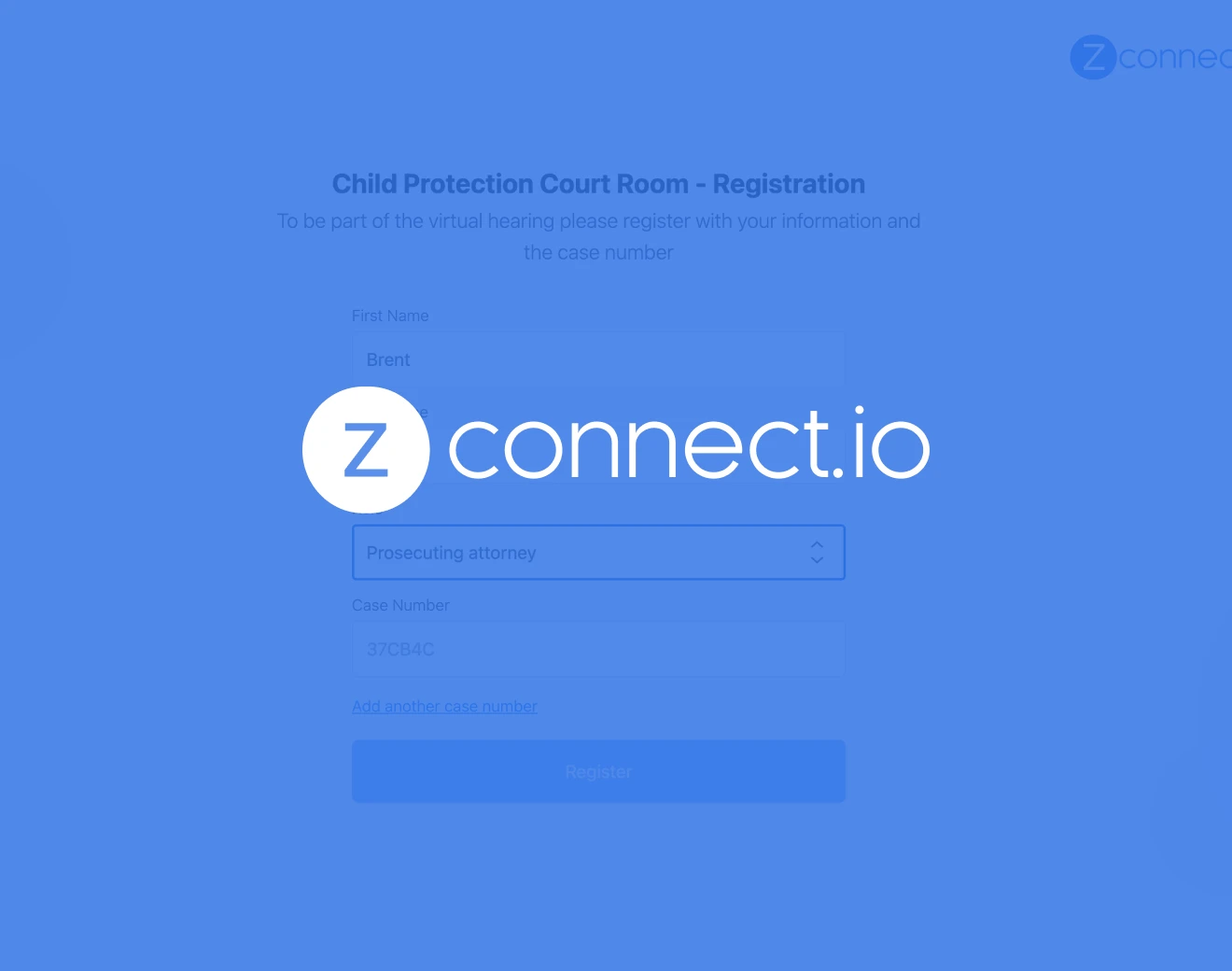
- Pre-registration by case. Participants register ahead of time and are grouped under the case they belong to, so staff know who to expect before a session starts.
- Clear role labels. Each participant carries a visible role, such as attorney or party, so the court can confirm who is who.
- Managed waiting rooms. Staff move people between waiting rooms and active sessions with a few clicks, keeping private matters private.
- Bilingual access. The interface is bilingual, so more participants can follow the process comfortably.
The result was a smoother, more organized virtual courtroom that reduced confusion for staff and participants alike.
Outcomes
What it made possible
- Court staff can pre-register participants, group them by case and see each person's role at a glance.
- Participants are moved between waiting rooms and sessions in a few clicks, so hearings stay organized.
- A bilingual interface makes the process more accessible to participants.
- Courts kept cases moving and protected privacy during one of the most disruptive periods in recent memory.